

 Tally
Tally Tally Customization
 Tally Implementation
 Tally Integration
 Tally Manpower Solutions







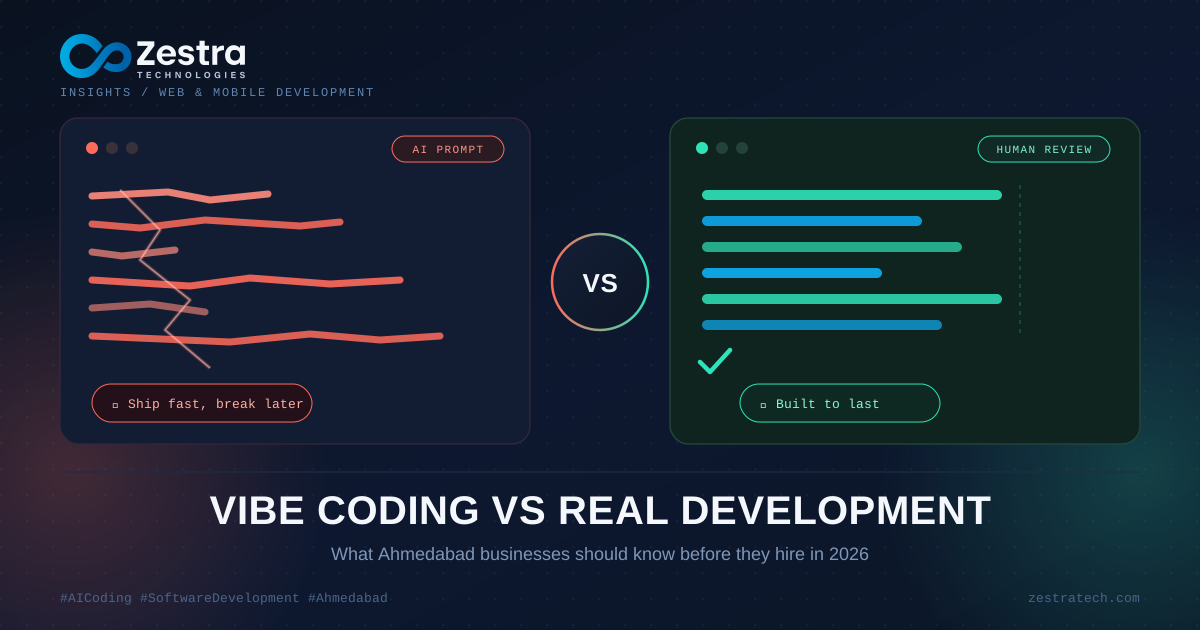
A client called us last month with a problem. His son had built the first version of their inventory app using an AI coding tool, over a weekend, and it looked great in the demo. Three months later, the app was leaking customer data in the browser console, the database had no backups, and nobody on his team could explain why orders sometimes duplicated themselves. He wasn't angry at his son. He was just confused about how something that worked so well on day one could fall apart so fast.
This is happening across Ahmedabad and Gujarat right now, and honestly, across the whole industry. So let's talk about it properly.
What "Vibe Coding" Actually Means in 2026
The term picked up steam because it describes something real: describing what you want in plain English, letting an AI model generate the code, and shipping it without really reading what got written. You're going on the "vibe" that it works, not on understanding what's under the hood.
And to be fair, it's not a scam or a fad that's going away. Tools like Claude, Cursor, and similar AI coding assistants are genuinely good now. Our own developers use them daily to speed up boilerplate, write tests, and explore ideas faster. The problem was never the tool. The problem is treating AI-generated code as a finished product instead of a fast first draft.
Where It Works Fine
There are places vibe coding is a genuinely smart choice:
- Internal tools nobody outside your team will ever touch
- Quick prototypes to test an idea before you invest real money
- One-off scripts for a task you'll run twice and forget
- Personal projects with no customer data involved
If a founder wants to validate an idea before committing budget, prompting an AI to build a rough version over a weekend is a perfectly reasonable move. We'd tell you the same thing.
Where It Quietly Breaks Businesses
The trouble starts the moment real users, real money, or real data enter the picture. A few patterns we keep seeing when businesses come to us after a vibe-coded product runs into trouble:
Security holes that look fine until they aren't. AI models write code that runs, but "runs" and "safe" are different things. API keys sitting in frontend code, missing authentication checks, SQL queries built by string concatenation instead of parameterized queries. None of this throws an error. It just sits there until someone finds it.
No architecture, just accumulated prompts. Real software is planned. You decide how data flows, how modules talk to each other, what happens when 10,000 users show up instead of 10. When a product is built prompt by prompt, it grows into a patchwork with no underlying plan, and every new feature gets harder to add than the last.
Nobody can explain the codebase. This is the one that costs businesses the most, actually. When something breaks at 11pm and your AI-generated app has no documentation and no developer who understands why a decision was made, you're stuck. You can't hire someone to fix it quickly because there's nothing to hand them.
Scaling becomes a rebuild, not an upgrade. A lot of AI-generated code is optimized to work, not to scale. It's common for what looked fine with 50 test users to fall over completely once real traffic hits.
Data handling gets treated as an afterthought. Backups, GDPR-style consent flows, proper data validation, none of that comes free just because the AI wrote functional-looking code.
What Changes When Real Developers Are Involved
This is really the whole point of a structured process, and it's why we still run every project through the same four stages regardless of how much AI tooling we use internally:
Discovery first. Before a single line of code exists, we understand what the business actually needs, not just what sounds good in a prompt. A lot of expensive rebuilds happen because nobody asked the right questions at the start.
Architecture before implementation. We plan how the system holds together before we build it, the same way you wouldn't start construction on a building without a structural plan, no matter how good your workers are.
Code review by a person who understands the business. AI can write a function. It can't sit in a room and ask "wait, what happens if two customers place an order for the last item at the same second?" That question comes from experience, not a prompt.
Testing and documentation that outlive the project. Good development leaves behind something maintainable. If we're not around next year, someone else should be able to open the codebase and understand it within a day, not a month.
Using AI tools inside this process makes us faster. Skipping the process and letting AI replace it is where things go wrong.
Questions to Ask Before You Hire Anyone for Development Work
If you're evaluating a developer, freelancer, or agency in 2026, these questions will tell you more than any portfolio:
- Who reviews the code line by line, and what's their process for it?
- What happens to my data if there's a breach, do you have a plan or just hope?
- Can you show me the architecture decisions before development starts, not after?
- If your team disappears tomorrow, can someone else pick up this codebase?
- How do you test before launch, and what does that actually involve?
If the answers are vague, that's your signal.
Where This Leaves You
AI coding tools aren't going anywhere, and honestly, they shouldn't. They make good developers faster and make experimentation cheaper for founders testing new ideas. But there's a real difference between a tool that helps you build and a process that makes sure what gets built actually holds up.
At Zestra, we use modern AI tooling across our web development and mobile app development work because it genuinely helps. What we don't do is skip the discovery, architecture, review, and testing stages just because a first draft came together quickly. That process is the actual product you're paying for, not just the code.
Got a Vibe-Coded Prototype That Needs to Become a Real Product?
Or starting fresh and want it built right the first time? Talk to our team — we'll tell you honestly what stage your project is actually at.