


 Tally Services
 Tally Customization
 Tally Implementation
 Tally Integration
 Tally Manpower Solutions

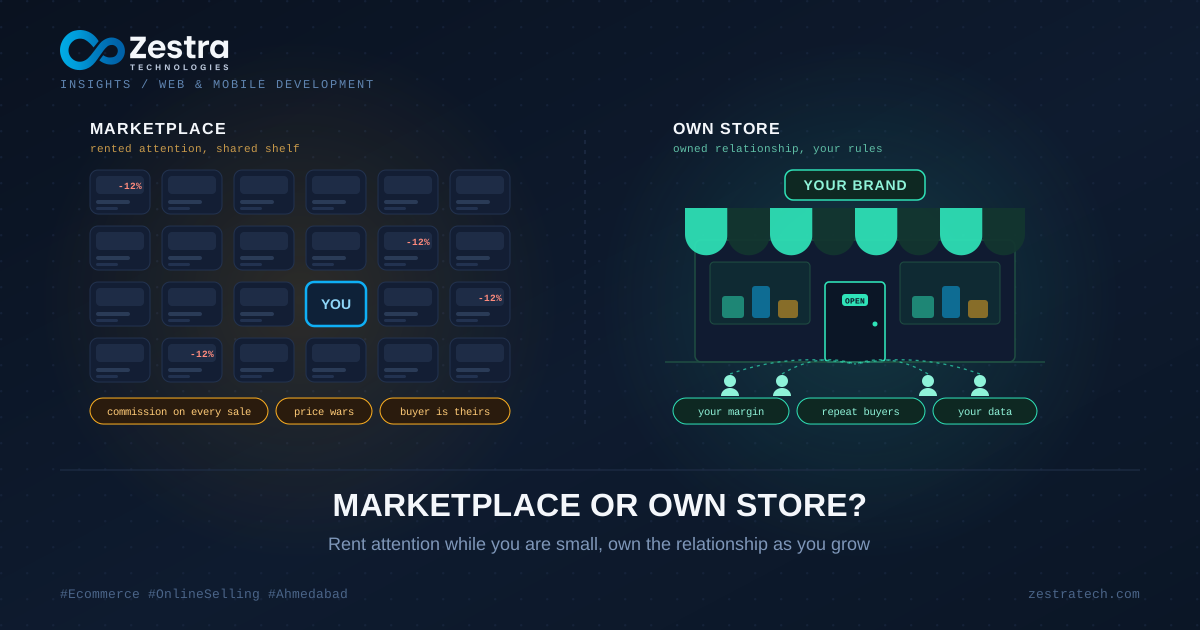
On a marketplace, the customer belongs to the marketplace. You get an order, an address to ship to, and a review if things go well. You do not get a relationship you can build on, and in most cases you are not allowed to try.
That one fact explains most of the trade-offs between selling on Amazon, Flipkart or Meesho and running your own website. Everything else, from fees to traffic to risk, follows from who owns the customer.
What a Marketplace Gives You
Demand that already exists. Millions of people open these apps with the intent to buy, and a new listing can be in front of some of them within days. For a seller with no audience, that is a large head start.
You also get a lot handled for you: payments, a trusted checkout, delivery networks, and a buyer who is comfortable paying an unknown brand because the platform stands behind the purchase.
What It Takes Back
Margin. Commission, fixed fees, shipping charges, return costs and advertising all come out of the sale. Each looks modest on its own. Add them up per order before assuming a product is profitable there.
Price control. Buyers compare identical products with one tap, so competing on price becomes the default, and it is hard to hold a premium.
Customer data. Platforms limit what you can see and how you can contact buyers. Repeat business, the cheapest kind, is hard to build when you cannot reach the people who already bought from you.
Stability. Listings get suppressed, categories get restricted, accounts get suspended, fee structures change. Any one of these can cut revenue sharply with little notice and little room to argue.
What Your Own Store Gives You
The customer relationship, fully. You hold the email and phone number, you decide the follow-ups, and you can bring someone back with a message that costs almost nothing. Your brand shows up properly, with your story, your photos and your packaging, instead of sitting in a grid beside forty lookalikes.
Margins are usually better too, since you pay payment gateway charges and hosting rather than a commission on every sale.
What Your Own Store Asks of You
Nobody arrives by default. A new store has no traffic, and every visitor has to be earned through search, social media, ads, WhatsApp, or word of mouth. First-time sellers tend to underestimate how long that takes. A well-built store with no visitors sells nothing.
You also take on the rest: payments set-up, shipping partners, returns handling, product pages that convince a stranger to trust a brand they have never heard of. All of that is manageable, but it is work.
Ask These Before Choosing
- Does your product already have people searching for it by category, such as "cotton kurti" or "protein powder"? If so, a marketplace can match you to existing demand.
- Is your product hard to find elsewhere, handmade, customised or tied to a brand story? That favours your own store.
- After every cost, what is the margin on one order in each channel?
- Do customers buy from you again and again, like food, skincare or refills? Then owning the relationship pays back quickly.
- Could your business survive if the marketplace account were paused for a month?
Starting on a Marketplace
It makes sense when you are testing whether a product sells at all, when your margins can absorb the fees, or when you have no audience and need first orders and reviews. Treat it as a way to learn what buyers want, and keep notes on what sells, to whom, and at what price.
Starting With Your Own Store
It makes sense when your brand is the product, when repeat purchases matter, or when you already have an audience on Instagram, WhatsApp or an offline shop to send to it. Our e-commerce development work usually begins by asking where the first hundred buyers will come from, because the answer shapes how the store is built.
Running Both
Many sellers end up here. A marketplace brings in new buyers, and a card or note in the parcel, where the platform's rules allow, invites them to your own site for the next order. Your store carries the full range and the better margins, and the marketplace carries a few bestsellers for reach. Check each platform's current policies on this before building a plan around it.
A Rule of Thumb
Rent attention while you are small, and build a place of your own while you grow. The order can change with your product and your audience, but the aim should stay the same: by the time you depend on one channel for most of your income, you should own at least one other.