







 Tally Services
 Tally Customization
 Tally Implementation
 Tally Integration
 Tally Manpower Solutions
A founder we spoke with in early 2026 had just hired two full-time developers for his logistics startup. Six months later, the product still wasn't live, one developer had left for a bigger salary elsewhere, and he was back to square one, except now three months behind and short on runway. He wasn't wrong to want an in-house team eventually. He was wrong about when.
That's really what this decision comes down to, and it's the part most comparison articles skip entirely while they hand you a pros and cons table.
The Table Everyone Shows You
You've probably already seen it. In-house gives you control and cultural alignment, but costs more and takes longer to build. Outsourcing is faster and cheaper, but you sacrifice some control and communication gets harder. All true. None of it tells you what to actually do with your specific business, right now, this quarter.
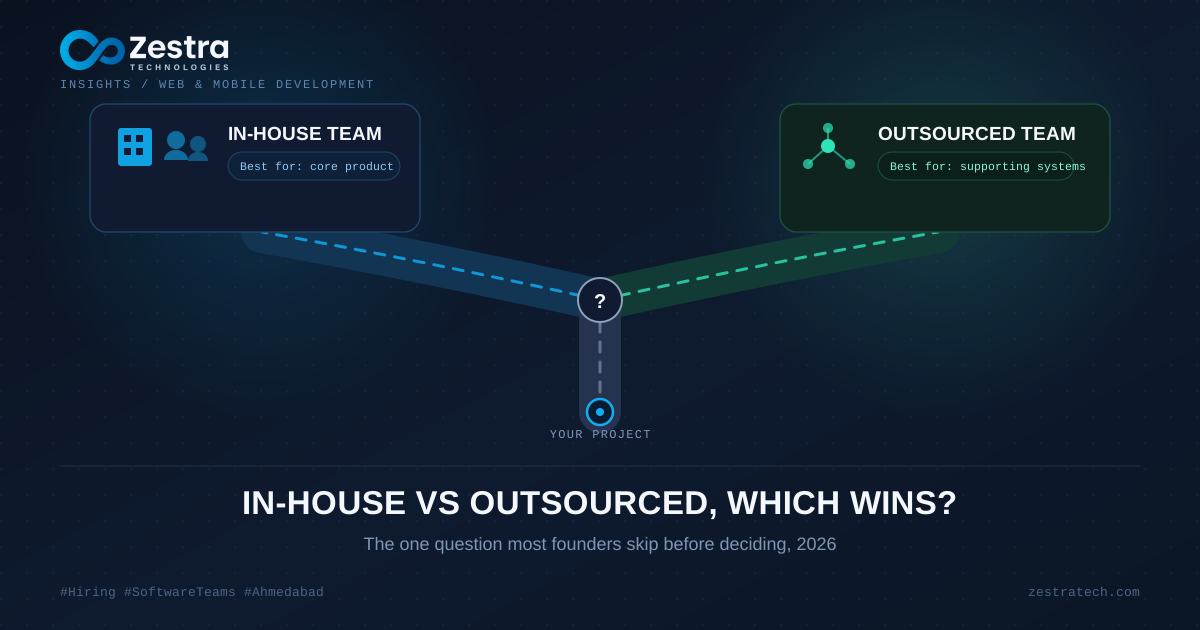
The real question isn't "which model is better." It's this: is software your product, or is software a tool your product needs?
If Software Is Your Product
If you're building a SaaS company, a fintech app, or anything where the software itself is what you're selling, the engineering team eventually needs to live inside the company. Product decisions happen daily, sometimes hourly, and a team that's deeply embedded in your users, your metrics, and your roadmap will consistently outperform one that's managing your account among five other clients.
But "eventually" is doing a lot of work in that sentence. Building an in-house team from day zero, before you've validated the product or found your first real customers, is how founders burn eighteen months of runway building the wrong thing really well. Most successful product companies we've watched start with a small outsourced or hybrid team to get to a working version, then transition core engineering in-house once the product direction actually stabilizes.
If Software Supports Your Business
If you run a manufacturing company that needs an inventory system, a clinic that needs patient management software, or a retail chain that needs an e-commerce platform, the software is infrastructure, not identity. You need it to work reliably and get maintained properly. You don't need five in-house engineers debating your tech stack when your actual business is selling steel pipes or running a pharmacy chain.
This is the majority of businesses that come to us in Ahmedabad, honestly. And for this group, the in-house team almost never makes financial sense once you count what actually goes into hiring.
What In-House Actually Costs, Beyond Salary
This is the part that trips people up. A developer's monthly salary is maybe forty percent of what they actually cost you.
Add recruitment time, and in Gujarat's current market, a decent full-stack developer takes anywhere from three to eight weeks to hire properly, sometimes longer for senior roles. Add onboarding, where a new hire typically takes one to two months before they're genuinely productive on your systems. Add benefits, PF contributions, and paid leave. Add the cost of a manager or senior developer to actually guide junior hires, because most first-time in-house hires for small businesses end up being one or two mid-level developers with nobody senior reviewing their architecture decisions. Add attrition. Average tenure for developers in Ahmedabad's IT market runs shorter than most founders expect, and every departure resets your onboarding clock.
None of this shows up in the offer letter. It shows up eight months later as a very tired founder wondering where the year went.
What Outsourcing Actually Costs, Including the Hidden Part
Outsourcing isn't free of hidden costs either, to be fair. The real risk isn't price, it's communication overhead and vendor lock-in. If your outsourced partner doesn't document decisions, doesn't give you code ownership, and becomes the only people who understand your system, you've just built a different kind of dependency, one that's arguably worse because it's contractual instead of just an HR problem.
The businesses that get outsourcing right treat the vendor relationship the way they'd treat a key employee: clear expectations, documented processes, and a contract that guarantees you own the code and can walk away with everything intact if the relationship stops working.
A Framework That Actually Helps
Instead of a pros and cons list, ask yourself these in order:
- Is this software going to be my core product, or does it support a non-software business? Core product, eventually in-house. Supporting tool, outsourcing usually wins long-term.
- Do I have someone technical enough to manage an in-house team's output, even if I don't code myself? If not, an in-house junior team with nobody checking their work is a slow-motion problem.
- Can I commit to twelve-plus months of stable hiring, or am I still validating the business itself? Instability plus in-house hiring is expensive twice, once in salary and once in the rework nobody senior caught in time.
- What happens to this project if my two best developers leave next month? If the honest answer is "we're stuck," that's true whether they're in-house or outsourced, and it means you need better documentation and code ownership regardless of which model you pick.
Where We Fit Into This
We run both models depending on what a client actually needs. Some businesses work with us through full project outsourcing when they need a system built and maintained without growing their own team. Others use our hire dedicated developer model, where our developers work as an extension of their team long-term, giving them more control without the overhead of building HR and recruitment infrastructure from scratch.
Still Deciding? Talk to Us Before You Commit.
If you're stuck deciding between building a team and finding a partner, talk to us before you commit to either. We'll tell you honestly which one fits your stage, even if the honest answer is neither, yet.