







 Tally Services
 Tally Customization
 Tally Implementation
 Tally Integration
 Tally Manpower Solutions
Most comparisons of these two frameworks are written by developers, for developers. This one is written for the person who has to make the actual decision.
If you've been researching mobile app development, you've almost certainly run into the Flutter vs React Native debate. It's one of those topics where everyone has a strong opinion, and the opinions frequently contradict each other.
The truth is less exciting: both are mature, production-ready frameworks, and both can build excellent apps. The real question isn't "which is better"; it's "which is better for your specific situation." That's what this article is actually about.
At Zestra Technologies, we've built production apps with both. Here's what we've learned from those projects: the honest version, not the marketing version.
A Quick Grounding: What Are These, Actually?
Flutter is Google's framework. It uses a language called Dart, which most developers learn specifically for Flutter. The key thing to understand is that Flutter doesn't use your phone's native UI components; it draws everything itself, using its own rendering engine. This is why Flutter apps look identical on iOS and Android: they're literally painting each pixel the same way on both platforms.
React Native is Meta's framework. It uses JavaScript (the same language used in web development) and React, which many front-end developers already know. Unlike Flutter, React Native translates your code into actual native components. A button in React Native becomes a real iOS button on iPhone and a real Android button on an Android phone.
This fundamental difference, Flutter painting its own UI vs React Native using native components, shapes almost everything else in this comparison.
How They Stack Up: The Stuff That Actually Matters
| Aspect | Flutter | React Native |
|---|---|---|
| Language | Dart | JavaScript / React |
| UI approach | Draws its own (pixel-identical cross-platform) | Real native components per platform |
| Best for | Custom, branded, animation-rich UIs | Standard UI patterns, JS-native teams |
| Library ecosystem | Growing, solid | Larger, more third-party packages |
| Hiring | Dart is quick to learn; growing pool | Huge JS/React talent pool |
| Performance edge | Animation-heavy apps & games (60–120fps) | On par for most apps (new JSI/Fabric arch) |
| Multi-platform | iOS, Android, Web, Desktop | iOS, Android (web via extra tooling) |
When Flutter Is the Right Call
Flutter shines when the visual experience of the app is central to what you're building. If your app needs to look the same on every device, if animations and transitions are a big part of the user experience, or if you're building something that doesn't need to "feel" like a standard iOS or Android app, Flutter is the stronger choice.
Some real examples where we'd recommend Flutter:
- Fintech and banking apps where you want a custom, branded UI rather than OS-default components
- E-commerce apps with rich product displays and smooth interactions
- Any app where you're eventually planning a web or desktop version (Flutter supports all platforms)
- Apps that need to look polished and distinctive, not utilitarian
One thing worth mentioning: Dart is genuinely easy to learn. Most developers with a JavaScript or Java background pick it up within a few weeks. The concern that "nobody knows Dart" is less true in 2026 than it was three years ago: Flutter's adoption has brought a lot of developers into the ecosystem.
When React Native Is the Right Call
React Native's biggest strength is that it fits naturally into web-first development teams and organisations. If your company already has JavaScript developers, they can pick up React Native significantly faster than learning Dart and Flutter. This reduces your hiring pool problem and lets experienced developers contribute sooner.
React Native also has a larger library ecosystem. More third-party packages means fewer custom solutions, and faster development for apps that need standard functionality: push notifications, maps, analytics integrations, and so on.
React Native makes most sense when:
- Your development team already knows JavaScript and React
- You want the app to feel authentically native on each platform
- You're building an app with fairly standard UI patterns (news, social, productivity tools)
- Speed to market is the primary constraint and you want to leverage existing web skills
Real talk: We've seen projects succeed and fail with both frameworks. The failure cases almost never come down to Flutter vs React Native; they come down to unclear requirements, poor planning, and not choosing an experienced development partner. The technology is rarely the issue.
What About Performance, the Thing Everyone Argues About?
In our experience, both frameworks perform exceptionally well for most apps. The performance gap between Flutter and React Native has narrowed significantly since React Native's new architecture (JSI and Fabric) landed. For most business applications, users won't notice a difference.
Where Flutter does genuinely win on performance is in animation-heavy applications and games. When you need 60fps or 120fps smooth animations consistently across devices, Flutter's custom renderer has a measurable edge.
Where React Native occasionally shows its seams is in complex UI with many simultaneous animations: the bridge between JavaScript and native can create bottlenecks. The new architecture mostly addresses this, but it's still a consideration for very performance-demanding apps.
The Question Nobody Asks: What Does Your Team Already Know?
In practice, the most important factor in choosing between these frameworks is often the simplest one: what does your development team already know?
If you're hiring Zestra Technologies for your project, we handle this decision for you based on your requirements. But if you have an internal team that will own the codebase going forward, their existing skills matter enormously. A Flutter app maintained by React developers is going to be a worse long-term outcome than a React Native app they're confident in.
Our Honest Recommendation
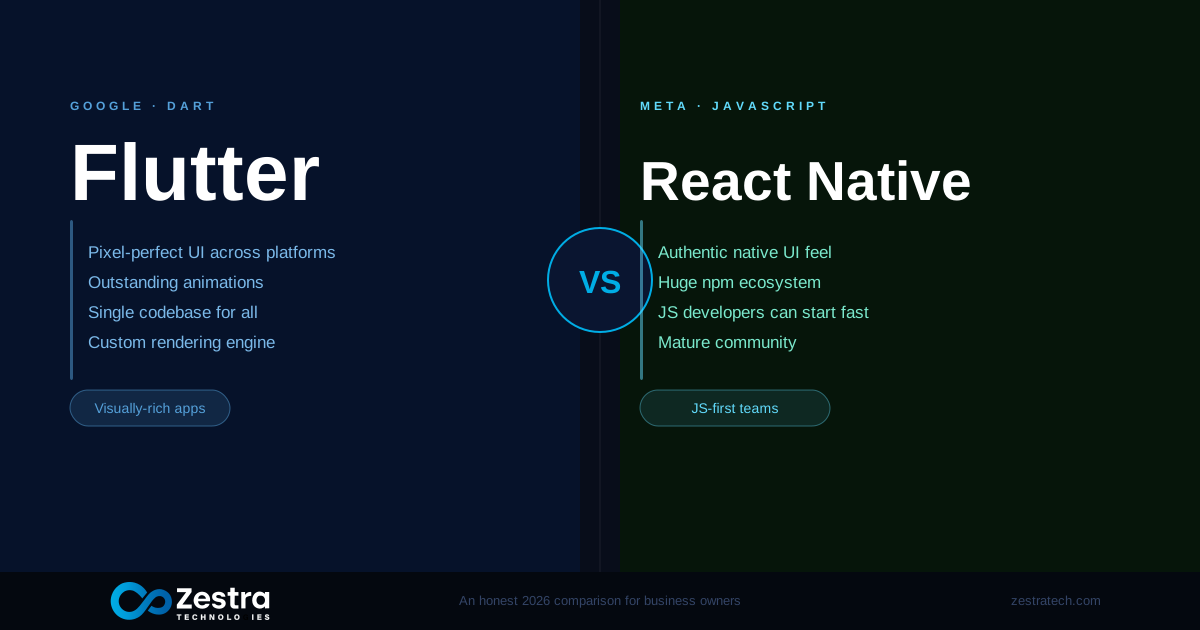
Choose Flutter for visually rich, custom-designed apps where the UI experience is the product. Choose React Native when your team is JavaScript-native and you want faster time to market with a more conventional development workflow. When in doubt, tell us what you're building and we'll advise specifically.
Mobile app development decisions made early in a project have long tails. The framework you choose shapes your hiring, your maintenance costs, and your ability to add features two years from now. It's worth taking the time to get this right, and getting advice from people who have built production apps with both, not just read about them.
Building a Mobile App? Let's Talk Technology First.
Tell us what you're building and we'll recommend the right framework for your goals, team, and budget. No obligation.