







 Tally Services
 Tally Customization
 Tally Implementation
 Tally Integration
 Tally Manpower Solutions

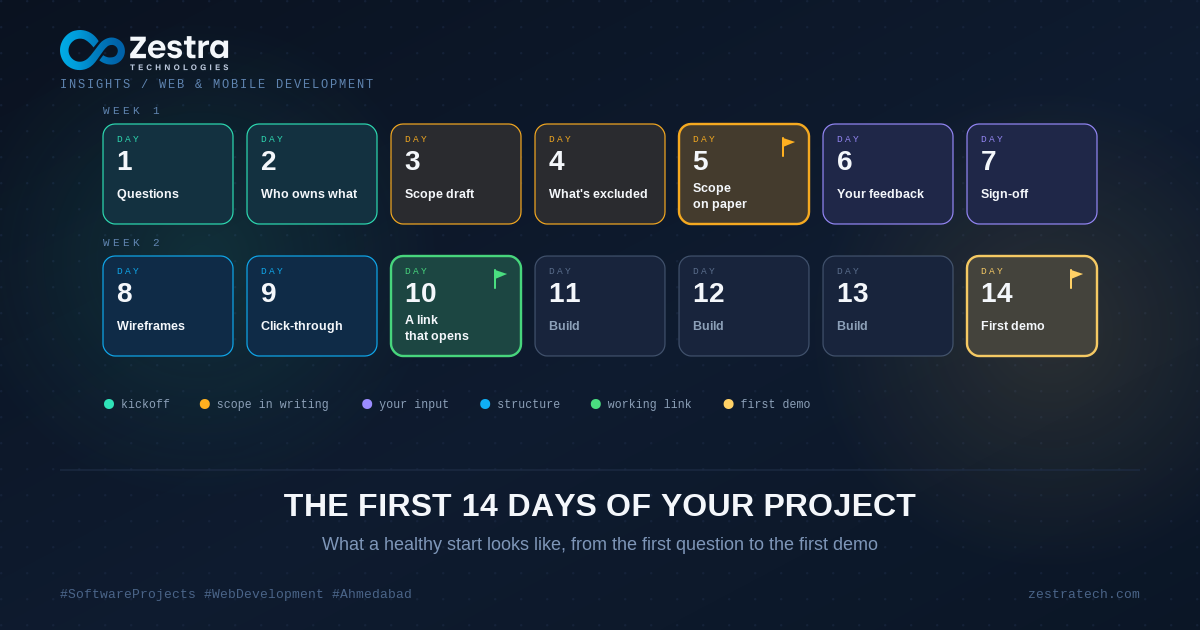
A proposal is a promise. The first two weeks are evidence.
You can't judge a developer's code if you're not a developer, and you shouldn't have to. What you can judge is how the team behaves once the contract is signed, and that behaviour is surprisingly easy to read. Here's what a healthy start looks like, in order, and what should make you pause.
Days 1 and 2: Questions, and a Name
The first thing that should happen is a lot of questions. Who are your users? What does a good result look like in six months? What do you already have: content, logos, data, an old system? What can't change? When does it have to be live, and why that date?
If nobody asks you anything, be worried. A team with no questions on day one hasn't thought about your project yet. It has thought about a project, probably a generic one.
You should also leave the kickoff knowing exactly who your contact is, how updates arrive (a call on Thursdays, a message at the end of each day, whatever suits you), and who on the team does what. Vague answers here turn into missed messages later.
Sort out ownership in the same breath. The code repository, the hosting account and the domain should either sit in your name or have a written agreement saying you'll receive full access. It's far easier to settle this on day one than in month eight.
Days 3 to 5: Scope on Paper
By the end of the first week you should be holding a written scope. Not a chat message saying "yes, we'll do all that." A document.
It should list the features, the pages or screens, and any integrations such as payments or a CRM. It should say what's included and, just as important, what isn't. It should name the things the team needs from you, like content, approvals and feedback, and give rough dates for each stage.
Look hard at the "not included" list. If a document has none, the boundaries are still vague, and that's where most arguments about extra charges start.
The Start of Week Two: Structure Before Polish
Before anything is coloured in, you should see how the thing is organised. For a website or app, that usually means wireframes or a clickable prototype: plain boxes showing what sits where and how a person moves from one screen to the next.
This is the cheapest moment to change your mind. Moving a box costs minutes. Moving a finished, coded screen costs days. Ask for a plain-language explanation of how data will be stored and which outside services are involved. You don't need the technical detail. You need to hear whether they've actually thought it through.
Midweek Two: Something That Opens
By around day ten there should be a link. A rough, ugly, unfinished version sitting at a private address, but a real thing you can open on your phone and click through.
It might only be a skeleton with a menu and two placeholder pages. That's fine. What matters is that work is happening somewhere you can see it, rather than inside slides and promises. Ask, too, whether the work is saved in a repository you can access. If the answer is hesitant, find out why.
Day 14: The First Demo
Close the fortnight with a call where the team shows what exists, tells you what's slipping, and says what they need from you. Pay attention to how they report problems.
Good teams bring bad news early and plainly. A team that only ever reports good news is either not looking closely or not telling you. A delay mentioned in week two costs you a conversation. The same delay discovered in week eight costs you the launch date.
Your Side of the Bargain
Projects slip because of clients too, and it would be unfair to leave that out. Late content, slow approvals, three people giving conflicting feedback, a new feature added every other day. Name one person who can make decisions for your side, send what you've promised on time, and collect your team's comments into a single message. A good team will remind you politely. A good client doesn't make them.
Warning Signs
If by day fourteen you've had no real questions, nothing in writing, no access to anything, no link to open, and a project manager who has changed twice, don't wait for things to improve by themselves. Raise it that week, in writing, and ask for a plan with dates.
It's possible to recover from a poor start. It's much harder to recover from a poor start you ignored for two months.
If you're comparing teams for an upcoming build, ask each of them to describe their first two weeks in this much detail. How specific the answers are will tell you more than a portfolio ever could. Our web development team is happy to walk you through ours.